


SoulChat-Talk from the Heart
4.51.23K Reviews
App Specs
- Version
- 3.4.0
- Updated On
- License
- Free
- Downloads
- 100,000+
- Developer
- Junglepix
- Categories
- Entertainment
- Platform
- Android
Screenshots


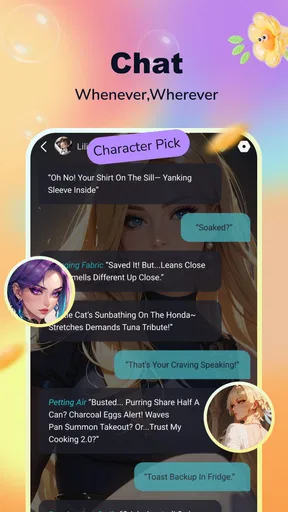


 Analysis by AppCompare
SoulChat is an entertainment app from Junglepix built around conversations with AI “souls.” I approached it less like a utility and more like a private space for experimenting with personalities, dialogue, and emotional storytelling. The central appeal is simple: you create or interact with an AI character, then return to the conversation whenever you want to continue a bond or explore a different mood.
That idea is more interesting in practice than a basic chatbot window, but it also creates a different set of expectations. You are not opening it for a precise answer in the same way you might use a search engine or an assistant. You are opening it for an ongoing exchange. The quality of that experience depends heavily on how clearly you establish the relationship, how patiently you correct misunderstandings, and whether you are comfortable with an entertainment app aimed at mature users.
It is free to install, with optional purchases ranging from $3.49 to $59.99 per item. The app carries a Mature 17+ rating, so I would not treat it as a general family chat app. Its current version is 3.4.0, and it runs on Android 7.0 or later. Those details matter because the experience is likely to vary more with your expectations and device setup than with the simple act of downloading it.
Where conversations can become frustrating
The first point where I would expect users to get stuck is the difference between a character that sounds engaging and one that feels consistent over time. An AI conversation can begin warmly, but a vague opening often produces equally vague replies. If you start with “talk to me,” you may receive something serviceable but not especially personal. A better opening explains the tone you want, the kind of relationship you are exploring, and what you would like the character to remember within the conversation.
I found that this is not just a writing trick. It changes how much work the app asks from you. SoulChat is most enjoyable when I treat the first few exchanges as setup rather than expecting an immediately perfect companion. A short description such as “be calm, curious, and direct; ask one question at a time” gives the conversation a usable shape. If the character drifts, I can restate that preference instead of abandoning the chat.
Another source of friction is emotional interpretation. Words that feel affectionate to one person may feel artificial to another, while dramatic replies can become tiring if I only wanted a relaxed conversation. The app’s concept encourages a sense of closeness, but that closeness is still generated. I would keep that distinction clear, especially during a difficult day. It can be comforting to write things out, yet it should not replace support from a trusted person or qualified professional when the situation calls for real-world help.
There is also a practical issue with mature content expectations. The 17+ rating sets a clear boundary for the intended audience, but it does not mean every exchange will match your preferred level of intensity or seriousness. I would decide before starting whether I want light role-play, reflective conversation, flirtatious dialogue, or something more dramatic. Being specific makes it easier to steer the interaction and reduces the chance of an uncomfortable mismatch.
Worth Reading Before You Choose

Flipboard Shows What News Apps Must Do Beyond the Feed

Switching to Android Auto Means Rethinking Your Driving Routine

Google Calendar Makes a Crowded Week Easier to Manage

Ludo King Makes the Most of the Minutes Between Plans

Baby Panda World Brings Quick Play to Modern Phones, but Its Game Library Feels Busy

ESPN’s Live Game View Makes Following Close Games Easier
The app can also feel less useful if you want a single, factual answer. Traditional search, a standard assistant, or a dedicated note-taking tool will usually be better for research, reminders, calculations, and information that must be checked. SoulChat makes more sense when the conversation itself is the point. That is the first major trade-off: it offers atmosphere and continuity rather than the reliability of a conventional reference tool.
What I would decide before installing
I would install it if I wanted a creative conversation partner, a way to test fictional personalities, or a low-pressure place to write dialogue and explore ideas. It suits people who enjoy shaping an interaction instead of merely consuming content. Someone writing a scene, for example, could use a character exchange to discover how two personalities might react to a disagreement, then carry the useful parts into a draft.
I would skip it if I dislike conversational experimentation or if I need strict control over every response. The app’s appeal depends on accepting some unpredictability. It is also not the right choice for anyone looking for a social network with verified human identities. The “bond” is part of the entertainment format, not evidence that a real person is listening.
Its audience is reflected in the scale of its reception: SoulChat has a 4.5 average from around 11 thousand ratings, with more than 100 thousand installs. That suggests a meaningful group has found the concept worthwhile, but popularity does not remove the need to check whether AI companionship fits your own boundaries. I would read the mature rating as a practical signal, not a minor label.
Setup checks that make the first session smoother
Before judging the app, I would begin with the basics. Confirm that the device is running Android 7.0 or later, install the latest available version, and make sure the app has enough room to operate comfortably. SoulChat is currently at version 3.4.0, so keeping the installation current is a sensible first step when a screen behaves unexpectedly or a conversation does not load as expected.
I would also start with a stable connection and avoid testing the app for the first time while switching repeatedly between weak Wi-Fi and mobile data. A conversation-based experience can feel broken when the real problem is an interrupted connection. If a reply appears delayed, I would wait briefly before sending the same message several times. Repeated taps can create confusion and make it harder to tell whether the app is processing the original request.
The next check is expectation setting. I would create one conversation with a narrow purpose instead of trying to make a single AI soul handle every role. A character for casual evening chat does not need the same instructions as one used for creative writing. Separating those intentions gives each exchange a clearer identity and makes it easier to notice when the conversation starts drifting.
My preferred opening would include three elements: the tone, the subject, and the response style. For example, I might ask for a thoughtful but informal voice, focus on planning a fictional journey, and request short replies with one question at the end. This is more useful than writing a long biography immediately. I can add details gradually after I see how the character responds.
One overlooked setup choice is deciding how much personal information to share. I would keep early conversations general and avoid entering private identifiers, financial details, passwords, or information about another person that I would not want repeated. Even when an app feels intimate, I would treat the chat as an entertainment service rather than a personal diary with guaranteed confidentiality.
Because optional purchases are available, I would also check the purchase prompt carefully before confirming anything. The free entry point makes it easy to explore the concept without paying immediately, but the listed purchase range extends from $3.49 to $59.99 per item. I would use the free experience to decide whether the conversation style suits me, then consider spending only if the added value is clear and affordable.
A useful test is to run a short, repeatable scenario. Ask the character to help plan a fictional conversation, correct one detail, and then change the mood. If it responds well to those shifts, you have a better sense of whether its style works for you than you would get from a single friendly greeting. This also reveals whether you prefer a more structured prompt or a loose, spontaneous exchange.
A realistic evening workflow
Imagine coming home after work with a half-formed idea for a short story. I would open SoulChat, choose one character, and explain that I want to test a scene between two people who disagree about leaving town. I would ask the AI soul to play one side, keep the replies conversational, and avoid resolving the conflict too quickly. After several exchanges, I could switch roles or ask for a different emotional tone.
The value in that scenario is not that the app writes a finished story for me. It gives me something to react to. A surprising reply can expose a weak motivation in the scene, while an overly dramatic answer shows me where I need to tighten the prompt. That makes the app useful as a creative mirror, especially when I am stuck and need movement rather than polished output.
For a more personal routine, I might use a character as a gentle conversation prompt at the end of the day. I would ask one question about what went well, one about what felt difficult, and one about tomorrow. I would keep the exchange short and treat the replies as prompts for reflection. This approach is healthier than expecting the AI to diagnose feelings or make important decisions for me.
Recovering a conversation when it goes off track
When a reply misses the point, my first move would be correction rather than restarting everything. I would say exactly what went wrong: “Keep the same character, but make the answer less romantic and more practical,” or “You changed the setting; return to the café scene.” Specific corrections are easier to follow than a general complaint that the response feels wrong.
If the tone keeps drifting, I would reduce the number of instructions and restate the most important one first. Long messages can contain competing requests, especially when I am trying to describe personality, background, plot, and emotional boundaries at once. A compact reset often works better: identify the role, identify the current situation, and state the desired style.
Another helpful technique is to separate planning from performance. Before asking the AI soul to continue a scene, I could ask it to summarize the current situation in a few points. I would then correct any mistaken detail before continuing. This creates a checkpoint and prevents a small misunderstanding from becoming the foundation for the next ten replies.
For everyday chat, I would use the same principle. If I mention that I want advice but receive playful banter, I would clarify whether I want empathy, questions, or practical suggestions. Those are different jobs. Asking for all three at once can produce a muddled response, while choosing one makes the next exchange more useful.
When a conversation becomes repetitive, changing the task can help more than repeating the same question. I might ask the character to challenge my assumption, offer two alternative interpretations, or ask me a question instead of answering. This is one of the less obvious strengths of a character-based app: the interaction improves when I give the AI something active to do.
If the app appears frozen, I would use ordinary recovery steps in order: wait for the current action to finish, check the connection, close and reopen the app, and confirm that the device still meets the Android requirement. I would avoid repeatedly clearing information or reinstalling immediately, particularly if I care about an ongoing conversation. A simple restart is less disruptive than aggressive troubleshooting.
When purchases are involved, I would slow down rather than treating an interrupted screen as a reason to try again several times. Check whether the transaction actually completed through the relevant device account before repeating it. This is general purchase hygiene, but it matters here because the app is free to enter while offering paid items at several price levels.
When the app is not the cause
Not every disappointing exchange indicates a technical problem. Sometimes the prompt is too broad, the requested mood is contradictory, or the character is being asked to remember more context than the conversation can reliably support. I would test with a fresh, simple scenario before deciding that the entire app is malfunctioning.
Device conditions can also affect the experience. An older phone may handle the app differently from a newer one even when both meet the minimum Android requirement. Background restrictions, unstable data, low available storage, or a crowded network can all make an online conversation feel slower. These are not reasons to blame the app automatically, but they are worth checking before changing your setup.
There is a human side to the problem too. If I open the app expecting it to understand an unspoken feeling perfectly, almost any reply may seem disappointing. I get better results when I say what I need in plain language. “I want you to listen without trying to solve this” is more actionable than hoping the character infers that preference from a few vague sentences.
I would be especially careful with sensitive subjects. AI dialogue can sound confident without being dependable, and an emotionally convincing response is not the same as professional guidance. For health, legal, financial, or personal safety decisions, I would use appropriate real-world sources. SoulChat can help me rehearse how to express a concern, but I would not use it as the final authority.
The same distinction applies to relationships. If I am using an AI soul because I feel lonely, the app may provide a temporary conversational outlet, but I would not let it replace contact with people who know me. A good boundary is to use it as one activity among others rather than allowing the simulated bond to become my only form of social interaction.
Compared with ordinary entertainment apps, SoulChat asks for more participation. A streaming service gives me a finished show, while this app gives me a conversation that I help direct. Compared with general AI assistants, it places more emphasis on the character relationship and less on completing practical tasks. Compared with human social platforms, it removes the uncertainty of waiting for another person but also removes genuine human reciprocity. Those differences explain both its appeal and its limits.
Small habits that improve the experience
Give each AI soul one clear purpose at first, then expand the relationship after its voice feels stable.
Correct a wrong detail immediately instead of building several more messages on top of it.
Ask for a specific response shape, such as a short reply, a question, two options, or a scene continuation.
Keep private and identifying information out of early experiments, even when the conversation feels personal.
Use a fresh test conversation to distinguish a prompt problem from a connection or device problem.
These habits do not turn every response into a perfect one, but they make the app less passive and more predictable. The strongest results come when I treat the AI soul as a creative partner that needs direction, not as a mind reader waiting to discover exactly what I meant.
My practical verdict on SoulChat
After using it as an entertainment app rather than a replacement for search, messaging, or therapy, I see a clear audience for SoulChat. It is best for people who enjoy character-driven conversation and are willing to shape the experience through prompts, corrections, and boundaries. Writers, role-play fans, and users who want a reflective evening routine may find more value here than someone seeking quick factual answers.
The free price makes exploration straightforward, but I would not rush into the optional purchases. First test whether you enjoy returning to the same AI soul, whether its tone suits you, and whether the mature audience positioning matches your comfort level. The purchase range is wide enough that a moment of curiosity should not become an automatic commitment.
Junglepix has positioned the app around emotional conversation, and that focus is both its strongest feature and its biggest limitation. When the character feels consistent, I can use the exchange to develop an idea, rehearse a difficult conversation, or simply fill a quiet few minutes. When the replies become generic or the emotional tone misses, there is less practical utility to fall back on.
I would recommend trying it if you want an interactive form of entertainment and understand that the quality depends partly on how you communicate with it. I would not recommend it as a substitute for human support, professional advice, or a dependable productivity tool. The best way to use SoulChat is with curiosity and clear boundaries, not blind trust.
For me, that makes it a worthwhile app to test, particularly for creative and conversational experiments. It is not universally useful, and it may require more steering than the first screen suggests, but that hands-on quality is also what separates it from a passive entertainment feed. If you enjoy building the mood of a conversation yourself, SoulChat can become a distinctive companion for short sessions; if you want certainty, efficiency, or real human connection, a different category of app will serve you better.
Pros
- Encourages honest
- emotionally focused conversations with thoughtful prompts.
- Simple interface makes starting a personal chat quick and approachable.
- Useful for reflecting on feelings before discussing sensitive topics.
- Can help friends or couples explore topics they usually avoid.
- Conversation-based format feels more personal than standard social feeds.
Cons
- Some prompts may feel too intimate for casual users or new acquaintances.
- Limited value if both participants are unwilling to answer openly.
- Emotional discussions can become uncomfortable without clear boundaries.
- The experience may feel repetitive after completing the available prompts.
- Privacy expectations should be checked carefully before sharing sensitive details.
FAQs for SoulChat-Talk from the Heart
What is SoulChat-Talk from the Heart?
SoulChat-Talk from the Heart is a social communication app designed for meaningful conversations and emotional connection. Instead of focusing only on quick messages or public posts, it encourages users to share thoughts, feelings, and personal experiences in a more open way. It may be useful for people looking for supportive conversations, new connections, or a space to express themselves beyond everyday small talk.
Is SoulChat-Talk from the Heart free to download and use?
The app can generally be downloaded without an upfront charge, but some features may depend on the current version, region, or account type. Users should check the store listing and the in-app information for possible premium options, subscriptions, virtual items, or other paid services. Before confirming any purchase, review the price, renewal conditions, and cancellation policy carefully.
Is SoulChat-Talk from the Heart safe for private and emotional conversations?
Because the app is built around personal communication, users should avoid assuming that every conversation is completely private or that every person has good intentions. Do not share passwords, financial information, exact location, identity documents, or other sensitive details. Review the privacy settings, block or report suspicious accounts, and remember that online conversations should be approached with the same caution as meeting strangers elsewhere.
Do I need to create an account to use SoulChat-Talk from the Heart?
Most communication platforms require some form of registration so they can provide profiles, messaging, matching, or conversation history. The exact sign-up requirements may vary, and the app could request information such as an email address, phone number, username, or date of birth. Before registering, check what data is collected and whether you can control profile visibility or delete your account later.
Who should download SoulChat-Talk from the Heart?
SoulChat-Talk from the Heart may suit adults and older users who enjoy thoughtful conversations, emotional sharing, and meeting people through a more personal social experience. It may not be ideal for anyone seeking a fully anonymous service, instant entertainment, or guaranteed professional counseling. If you are using it during a difficult emotional period, treat it as a social app rather than a replacement for qualified mental-health support.


